Reinforcement Learning for Phylogenetic Trees
Reproducing and extending an RL approach to building evolutionary trees.
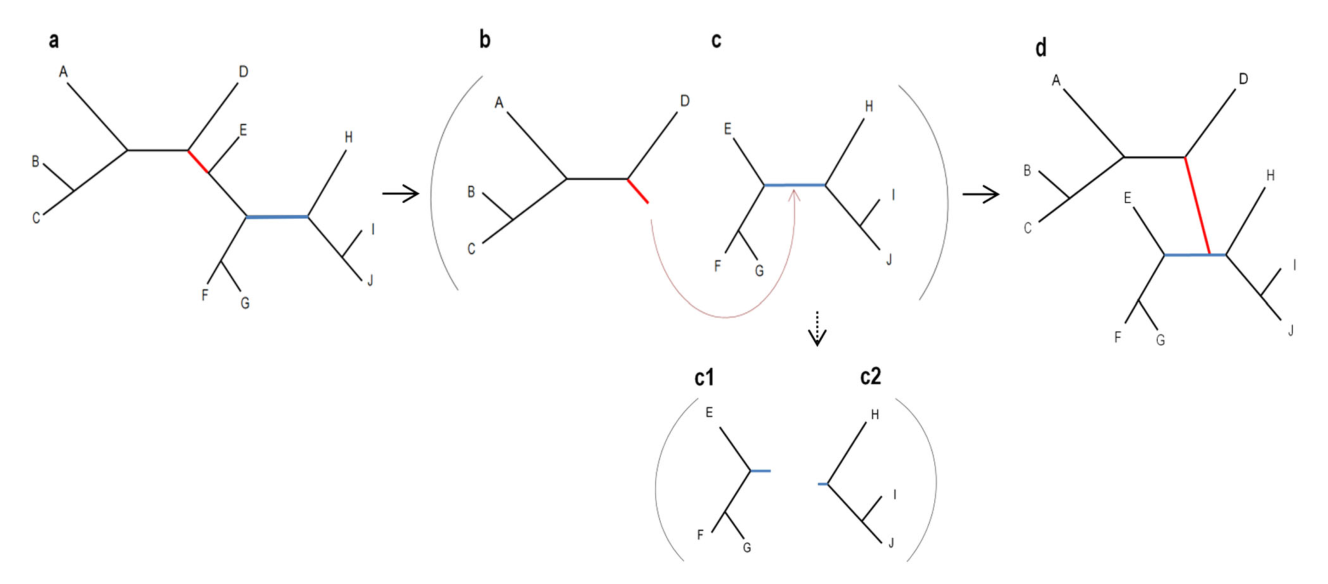
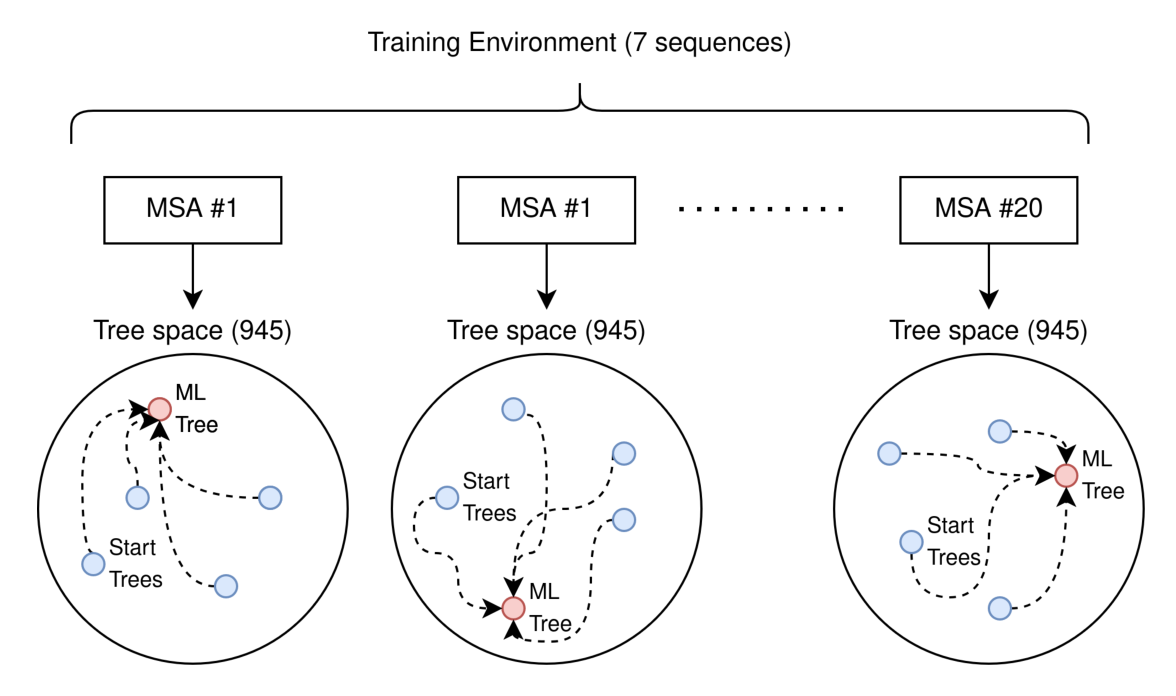
For the Advanced Deep Reinforcement Learning seminar at Leiden University, my partner and I reproduced and extended a recent scientific paper: treat the search for the best evolutionary tree as a reinforcement learning problem. Every epoch, the agent starts from a random starting tree and repeatedly rearranges it using Subtree Prune and Regraft (SPR) moves. The reward is defined as how much better the new tree describes the relationship between nodes (DNA sequences) over the starting tree. We began by re-implementing and optimizing the method of Azouri and colleagues, and followed this up with our own extensions on top of it, which we documented in the form of a scientific paper.
What we added
We first reproduced their deep Q network baseline, then tried to address the gaps in their approach with our own extensions. The main addition is a Soft Q Learning agent with entropy regularisation, which learned more reliably and with less variance than the baseline. We extended the hand crafted features the agent sees, added a faster feature extraction pipeline, and swept the discount factor. One revealing insight we gained is that a near sighted agent did just as well as a far sighted one, which raises a fair question about where the original method’s gains really come from, and whether the reinforcement learning approach even carries merit for this task.
As a proof of concept we also tried a graph neural network policy that reads the tree structure directly instead of relying on hand crafted features. It learned, but was slower and did not outperform the feature based agent, so we kept it as an experiment rather than the headline result.
This was a two person seminar project and a reproduction of published work rather than something we invented from scratch. The full write up, extensions and their limits are in the paper.